
On 11 and 12 March, 2026, the Swarmchestrate partners travelled to Ljubljana, Slovenia. Hosted by Prof. Vlado Stankovski and the University of Ljubljana, Faculty of Computer and Information Science, we enjoyed two days of intense collaboration, innovation, and —of course— city walks and great coffee!
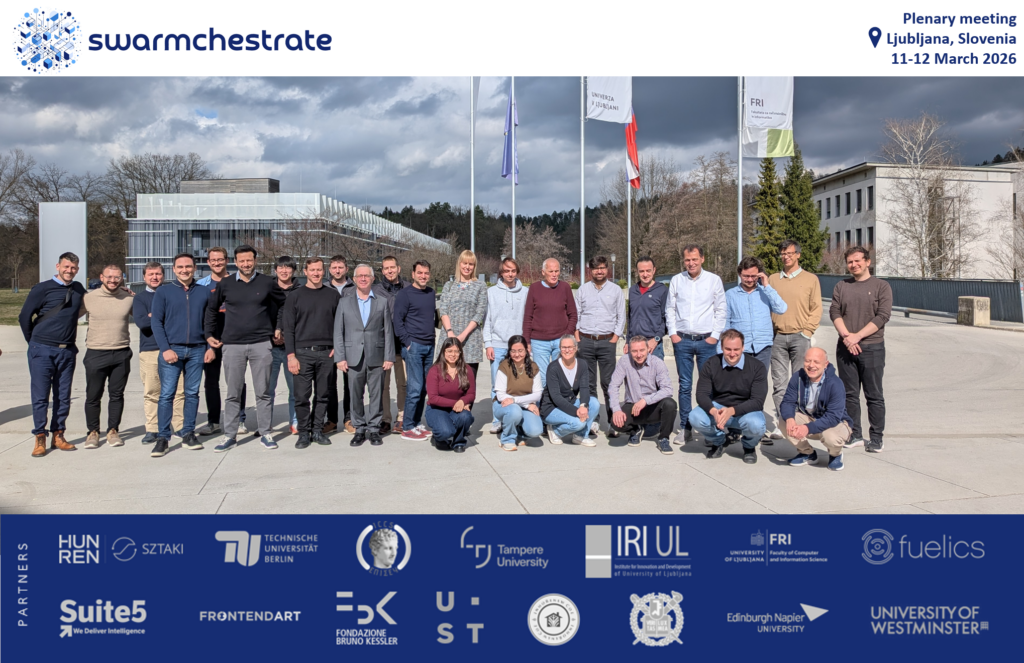
Swarmchestrate Consortium partners in Ljubljana, March 2026 (© Swarmchestrate consortium 2024-2026)
During the 1st day, discussions focused around the core pillars of the project:
🔹Intelligent Orchestration & Monitoring: Refining how we manage complex, distributed swarms.
🔹AI & Federated Learning: Balancing privacy and practicality in local vs. federated training models.
🔹Knowledge Management: Ensuring seamless data flows and integration across the continuum.
🔹Real-World Demonstrators: Moving from theory to practice with our latest prototype demos.
On the 2nd day, after a morning spent refining our project impact and addressing key milestones, we split into two technical breakout sessions to bridge the gap between theory and deployment.
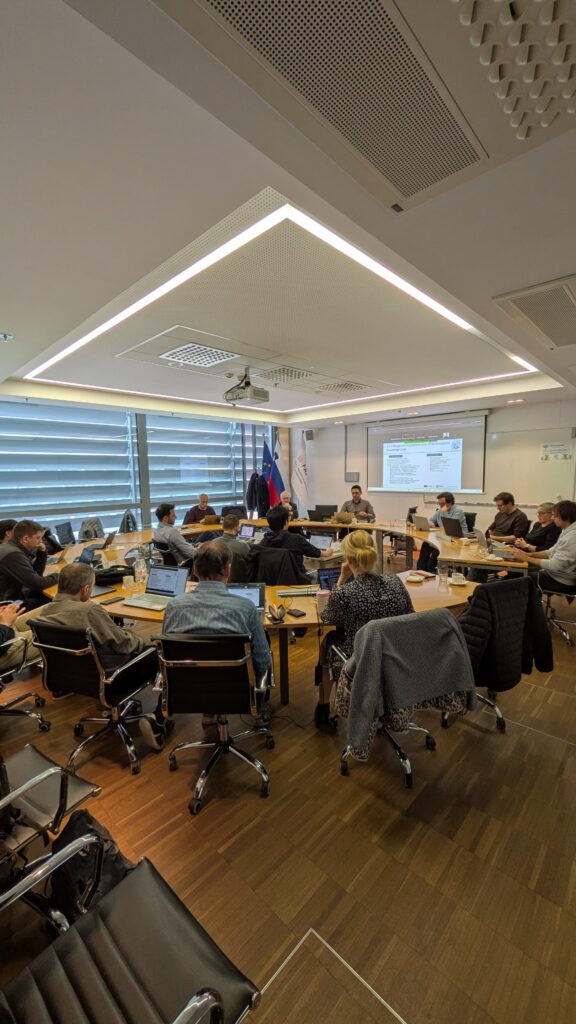
Swarmchestrate Consortium partners in University of Ljubljana, Faculty of Computer and Information Science, March 2026
(© Swarmchestrate consortium 2024-2026)
Day 2 “hands-on” focused on:
🔹System Integration: mapping out the roadmap for our deployment prototype, specifically focusing on the seamless integration of monitoring tools and OptimusDB.
🔹Demonstrator Development: a practical session on creating application templates using TOSCA, ensuring our use cases are ready for real-world validation.
The project coordinator is HUN-REN SZTAKI, a Hungarian research institute; among the 15 project partners, we find universities, research institutes and companies from 10 different EU countries, the UK and Korea. The technical coordination lies with the University of Westminster, represented in this project by the Centre for Parallel Computing (CPC), a centre of excellence and one of the leading and most successful research hubs within the University. The project is funded with €4,3 million from the European Union’s Horizon Europe Programme, with £938.271 coming from the UKRI and with €356.229 from the Seoul National University (Institute of Engineering Research) and the National Research Foundation of Korea (NRF) (funded by the Korea government, Ministry of Science and ICT -MSIT).
Follow us on LinkedIn, BlueSky and YouTube. Subscribe to our Newsletter to keep up the pace with the project’s developments!